Bits of Torah Truths – #Torah Concept in the NT: Remember Those Who Suffer – Episode 706
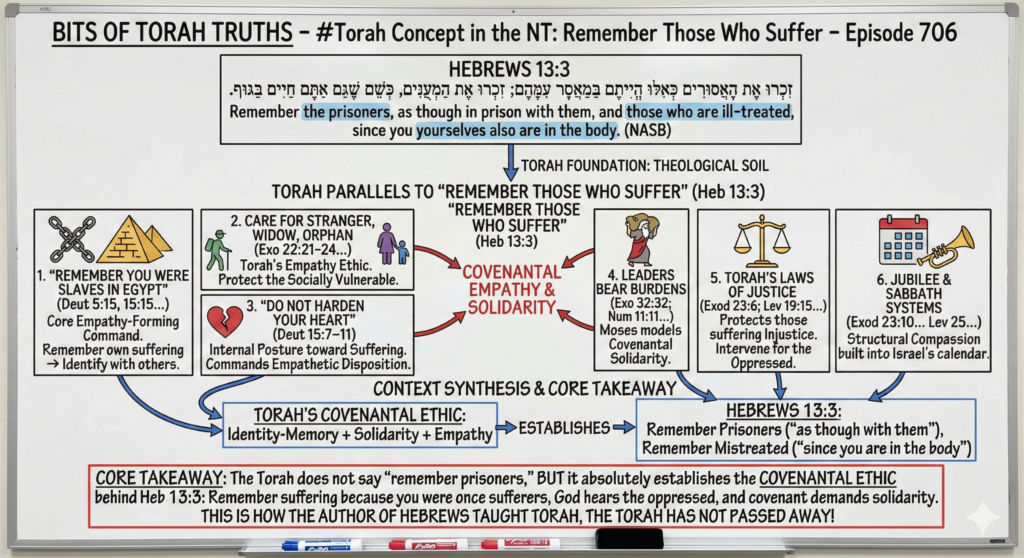
Hebrews 13:3
זִכְרוּ אֶת הָאֲסוּרִים כְּאִלּוּ הֱיִיתֶם בַּמַּאֲסָר עִמָּהֶם; זִכְרוּ אֶת הַמְעֻנִּים, כְּשֵׁם שֶׁגַּם אַתֶּם חַיִּים בַּגּוּף.
#torah #torahwisdom #torahtruth #torahforlife #torah4you #torahtruth
Hebrews 13:3
13:3 Remember the prisoners, as though in prison with them, and those who are ill-treated, since you yourselves also are in the body. (NASB)
https://www.matsati.com/index.php/category/bits-of-torah-truths/
This is quite foundational in the Torah: while Hebrews 13:3 explicitly commands believers to “remember those who are in chains” and “those who are mistreated,” the Torah embeds this ethic through identity‑memory, solidarity, and covenantal empathy. The Torah doesn’t use the same wording, but it absolutely establishes the theological soil from which Hebrews grows.
– Torah Parallels to “Remember Those Who Suffer” (Hebrews 13:3) –
- “Remember that you were slaves in Egypt” the core Torah foundation. Deut. 5:15, 15:15, 16:12, 24:18-22 This is the Torah’s primary empathy‑forming command. Israel must remember their own suffering so they will identify with others who suffer.
- Care for the stranger, widow, orphan Exo. 22:21-24, Deut. 10:18-19, 24:17-21 the Torah’s empathy ethic. The Torah repeatedly commands Israel to protect those who are socially vulnerable.
- “Do not harden your heart” Deut. 15:7–11 the Torah’s internal posture toward the suffering. The Torah doesn’t just command action; it commands empathetic disposition.
- Israel’s leaders must bear the burdens of the people Exo. 32:32, Num. 11:11-17, Deut. 1:12 Moses models covenantal solidarity with the suffering.
- The Torah’s laws of justice protect those who suffer injustice Exod. 23:6, Lev. 19:15, Deut. 24:14-15 The Torah repeatedly commands Israel to intervene for the oppressed.
- The Jubilee and Sabbath systems institutionalize care for the suffering Exod. 23:10-11, Lev. 25, Deut. 15 The Torah builds structural compassion into Israel’s calendar.
– Context Synthesis –
- Remember your suffering: Egypt slavery, Empathy through identity, Remember prisoners as though with them.
- Care for the vulnerable, Stranger, widow, orphan, God identifies with the oppressed, Remember the mistreated.
- Soft‑hearted compassion Deut. 15 Internal empathy, “As though you yourselves were suffering.”
- Leaders bear burdens: Moses, Christlike solidarity, Covenant solidarity with sufferers.
- Justice for the oppressed: Torah legal code, Protect the weak, Remember those mistreated.
- Structural compassion: Jubilee, Sabbath, Institutional empathy, Ongoing remembrance of sufferers.
– Core Insight –
The Torah does not say “remember prisoners,” but it absolutely establishes the covenantal ethic behind Hebrews 13:3: Remember the suffering because you were once sufferers, because God hears the cries of the oppressed, and because covenant identity demands solidarity. This is how the author of Hebrews taught Torah, the Torah has not passed away!
Visual Summary of Concepts the Torah in the NT